
Experts Warn of Forward Trade Dangers to Pulses Industry Health


Current State of Pulses Trading
The pulses market is currently facing challenges due to forward trading practices that are impacting its balance. Traders and analysts discussed these issues at a recent virtual Agriculture Roundtable focused on pulses.
“Despite the risks, traders continue to engage in forward trade. I told them this isn’t a game of chance but a serious market,” remarked Hiten Kataria, a partner at Sunraj Group in Mumbai, highlighting the precarious nature of trading.
Agricultural economist Deepak Pareek also voiced concerns, suggesting that many are treating trading like a game of chance and not adhering to established market practices.
Logical Gaps in Trading Practices
Kataria emphasized the illogic in trading practices, where forward contracts are being signed without sufficient crop data. “We’ve never faced a year like 2024, where defaults left many traders with losses,” he pointed out.
Forward trading generally entails agreements to deliver commodities at a future date. For instance, contracts for Brazilian crops may be established months ahead of planting seasons.
Himanshu Pandey from Valency International noted that the market for pigeon peas has been particularly volatile over the last few months, with significant supply chain disruptions causing delays and quality issues.
Market Fundamentals Under Strain
Sunil Patwari, Managing Director of Season Overseas, noted new sources of pigeon peas are emerging in Africa. “Uganda and Nigeria are stepping in as new producers, which complicates the trading landscape,” he highlighted.
Patwari lamented that forward trading has distorted price fundamentals. For instance, chickpeas were sold for $920 per tonne in August but have since seen price declines, leaving traders scrambling.
Shyam Narsaria, CEO of Arvee International in Myanmar, praised the absence of forward trading in his country. “Last year’s good prices encouraged more farming, which is now reflected positively,” he stated, although prices have recently dropped to around $700 per tonne.
Tanzania’s Regulatory Changes
Guru Ravivarma from RV Exports in Tanzania shared that it’s now mandatory for all agricultural products to be sold through the Tanzania Mercantile Exchange (TMX). “This ensures exports are documented and traceable,” he explained.
Pandey observed that this mandate has left traders at a disadvantage. “TMX benefits the most from this arrangement, as it charges a three percent fee on volume traded,” he noted.
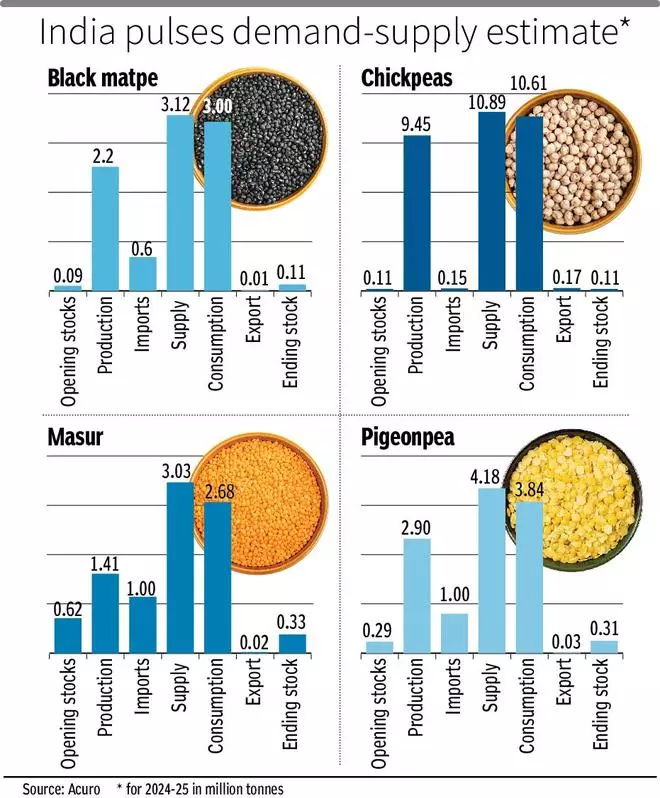
Pareek informed that global pulses production is currently at 92 million tonnes, while demand stands at 119 million tonnes for nutritional security. India’s production is at 24 million tonnes, with imports reaching 6.6 million tonnes.
Yield Concerns Amid Market Shifts
Harsha Rai from Mayur Global mentioned that despite an increase in lentil cultivation area, yields have suffered. The government’s 5.5 lakh tonnes of buffer stock has left many wondering when these stocks will be released.
Jay Saraff from Mandala Trading in Sydney remarked that Australia does not foresee issues from India potentially reintroducing duties on pulses, as this might lead to price corrections globally.
Deepak Rawat, a trader with Empros International in Canada, predicted a reduction in pulses production due to climate change, stating that there is a transfer of beans and pulses from Canada to India.
Tanmay Kumar Deepak from AgriWatch highlighted that Karnataka’s procurement strategies might lure farmers from neighboring states to sell their produce there.
Published on March 5, 2025
What are your thoughts on the current state of pulse trading? Let us know in the comments!

Introduction A significant development in global connectivity is underway, as a new cable system aims to link India, the Middle Read more
Expansion Plans for Bharti Airtel in Africa Bharti Airtel is reportedly eyeing a potential acquisition of a smaller telecommunications operator Read more

Seacom's Major Submarine Cable Network Upgrade Seacom is embarking on a significant enhancement of its submarine cable network along the Read more

## Jolla's Expansion into the African Market Jolla has recently unveiled plans to establish a Sailfish OS ecosystem in Africa, Read more