
Exploring the Current Landscape of Inequality in India

The story so far: A recent report from the World Bank has sparked intense discussions regarding inequality within the Indian economy. It highlighted several positive outcomes, such as a significant decline in extreme poverty and a decrease in inequality levels. The Gini coefficient—a measurement of inequality ranging from 0 to 1, where 1 indicates high inequality—fell from 0.288 in 2011-12 to 0.255 in 2022-23. This statistic positions India as having one of the lowest inequality levels globally.
What followed?
This finding was emphasized by the government as a validation of its economic policies and growth management. Nonetheless, numerous analysts argue that the data presented by the World Bank does not truly reflect the inequality situation in India. While some may contest that consumption inequality is on the lower side, income and wealth inequality remain exceedingly high and have exacerbated over time, ranking India among the most unequal economies worldwide.

What is consumption inequality?
The World Bank report focuses on consumption inequality, rather than income or wealth inequality, which raises several concerns. Primarily, consumption inequality is typically lower than that of wealth or income. A household with limited resources tends to spend most of its income on essential needs, leaving minimal room for savings. Consequently, if such a household’s income doubles, its consumption won’t increase proportionately, leading to a lower consumption inequality rate.
Also Read: Does inequality lead to growth? | Explained
Moreover, methodological issues arise with the databases used for assessing inequality. The Household Consumption Expenditure Surveys (HCES) from 2011-12 and 2022-23 provide valid data on low expenditure levels, yet they often overlook exceptionally high incomes, resulting in a skewed understanding of inequality. Significant methodological shifts between the two surveys also create compatibility issues, complicating comparisons over time. Notably, even the official 2022-23 HCES data warns against simplistic comparisons.
What are the levels of income and wealth inequality?
Thus, the low Gini coefficient mentioned by the World Bank pertains to consumption inequality and doesn’t readily translate to global income inequality levels. So, how can we accurately assess income inequality in India?

Determining the actual levels of income and wealth inequality in India poses a challenge, as official surveys often miss high-income brackets. Researchers at the World Inequality Database (WID), led by Thomas Piketty, have utilized various data sources, including national surveys and tax records, to derive more accurate inequality indicators. The findings paint a stark picture of inequality in India.
For instance, the Gini coefficient for pre-tax income in India for 2022-23 stands at 0.61. Among the 218 economies evaluated by WID, 170 exhibit lower inequality levels, categorizing India as one of the most unequal nations. Wealth inequality paints a similarly concerning picture; with a Gini coefficient of 0.75, it’s evident that wealth is far more concentrated than income or consumption. Despite this high wealth Gini, other countries exceed India’s concentration levels.
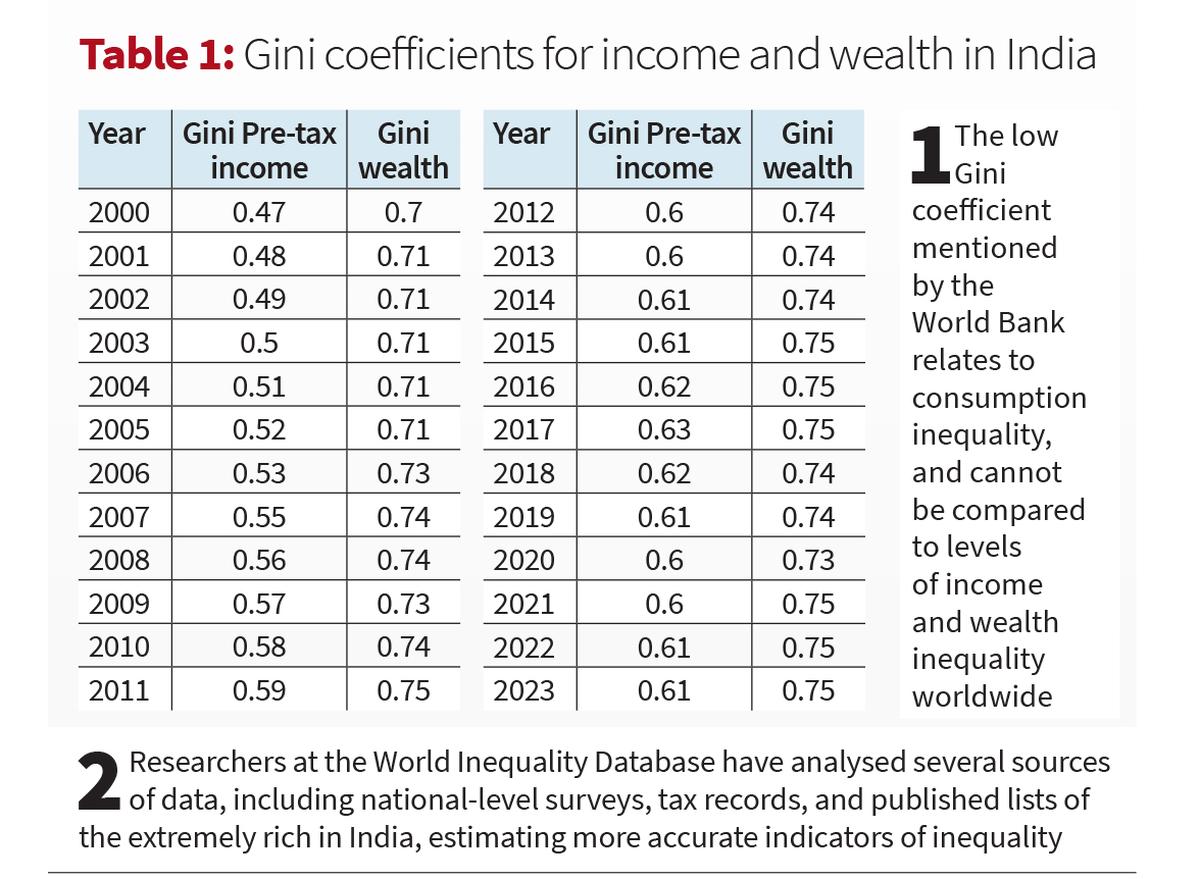
Data indicates a notable rise in the income Gini coefficient, which increased from 0.47 in 2000 to 0.61 in 2023. Wealth inequality has also escalated, albeit at a slower rate, moving from 0.7 in 2000 to 0.75 in 2023. Clearly, the narrative of low and declining inequality promoted by the World Bank does not align with India’s present situation.
Moreover, the Gini coefficient often downplays the extreme concentration of wealth prevalent in India today. As an aggregate measure, it does not fully illustrate the share of wealth held by a small segment of the population. Notably, in 2022-23, the top 1% of individuals in India controlled nearly 40% of the nation’s net personal wealth, making India one of the most unequal economies globally. Only Uruguay, Eswatini (Swaziland), Russia, and South Africa surpass India in terms of wealth concentration.
Is a reduction in consumption inequality on expected lines?
The prevailing trend over recent decades reflects a rise in both incomes and inequality, rather than a decline. Therefore, a reduction in consumption inequality is not entirely unexpected. As incomes rise—assuming the real incomes of the poorer segments do not drop—it’s likely that consumption for these households will increase relatively more than for those in the middle and upper classes, who might save more from their rising incomes. Higher incomes among the affluent facilitate saving, which further compounds wealth accumulation.
This phenomenon implies that consumption inequality can diminish even as income and wealth inequality escalate. These conditions paint a clear picture of the Indian economy today. What is crucial to acknowledge is the extreme concentration of wealth and income on top of this growth trajectory, positioning India among the most unequal economies worldwide and raising questions about the implications for future economic growth prospects.
Rahul Menon is an Associate Professor in the Jindal School of Government and Public Policy at O.P. Jindal Global University.
Published – July 13, 2025 01:20 am IST
What are your thoughts on the current state of inequality in India?

Introduction A significant development in global connectivity is underway, as a new cable system aims to link India, the Middle Read more
Expansion Plans for Bharti Airtel in Africa Bharti Airtel is reportedly eyeing a potential acquisition of a smaller telecommunications operator Read more

Seacom's Major Submarine Cable Network Upgrade Seacom is embarking on a significant enhancement of its submarine cable network along the Read more

## Jolla's Expansion into the African Market Jolla has recently unveiled plans to establish a Sailfish OS ecosystem in Africa, Read more