
Global Pulses Prices Plummet as Canada, Australia, Russia, and Africa Compete

Recent trends show that the prices of major pulses have hit historic lows globally. Countries like Canada, Australia, Russia, and several African nations are fiercely competing to capture market share. In the past month, prices for various pulses have dropped significantly, ranging from 5% to 20%, thanks to a bountiful harvest of peas and lentils.
This situation poses challenges for Indian farmers who are either currently harvesting or preparing to harvest their crops. The recent torrential rains in regions like Madhya Pradesh, Maharashtra, and Uttar Pradesh have adversely impacted crops such as urad (black matpe), tur (pigeon peas), masur (red lentils), and moth dal (green lentils).
A trader, who wished to remain anonymous, stated, “Imported pulse prices have reached unprecedented lows. There’s minimal price differentiation between Canada, Australia, and Russia. Yellow peas, in particular, are at a record low.”
Significant Lentil Surplus
For the 2025-26 marketing season (August-July), Canada has reportedly increased its dry pea cultivation by 9%, covering an area of 1.42 million hectares. The forecast for yellow pea production stands at 3.2 million tonnes, complemented by an estimated 550,000 tonnes of green peas. Consequently, Canada is anticipated to export over 2 million tonnes of peas.
Moreover, Canada’s chickpea yield is projected to exceed 340,000 tonnes, with exports potentially reaching a record 235,000 tonnes. Meanwhile, Australia’s chickpea production is forecasted at 2.1 million tonnes, reflecting a 7% decline from the previous year.
The surplus of lentils seems poised to rise significantly. Australia’s lentil production is predicted to soar by 34% to reach a record 1.7 million tonnes in 2025-26, significantly surpassing the 10-year average. According to Statistics Canada, the country’s lentil crop is also set to see substantial growth, with projections of 2.75 million tonnes, marking a 12-year high.
Increased Competition
In addition to these contenders, pulses from the US, Russia, Tanzania, Malawi, Mozambique, Myanmar, and Brazil are likely to flood the global market.
Among the various pulse crops, urad has maintained a steady trend, as Myanmar depletes its inventories from a bumper harvest in January. India’s crop, however, is under threat due to adverse weather conditions in key growing states.
Data from the Global Pulse Confederation (GPC) indicates that urad prices remain stable, with Myanmar quoting prices around $870 (₹77,240) per tonne for superior quality, while Brazil is slightly higher at $900 (₹80,000). Prices have remained relatively unchanged throughout the past month.
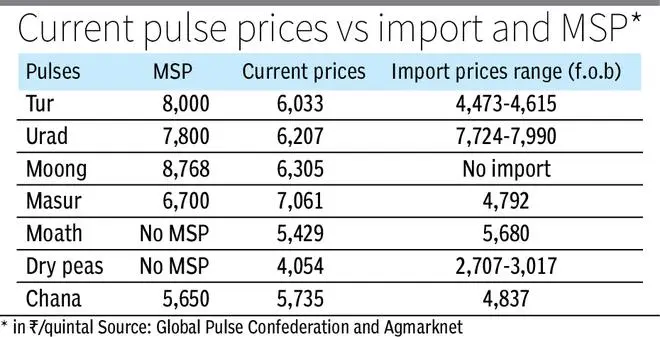
Unfortunately, most imported pulse prices are falling below the minimum support prices, except for urad. This is particularly concerning, as domestic prices for tur, urad, masur, yellow (dry) peas, and chana are currently lower than the landed rates of imports.
Declining Masoor Prices
In terms of tur, prices have seen a 5% dip in the last month. Myanmar is currently offering tur at $690 per tonne (₹61,240), while African countries such as Tanzania, Mozambique, and Malawi present competitive pricing at $520 (₹46,150), $540 (₹47,940), and $510 (₹45,275) respectively.
Masoor prices have also sharply declined, with Canada reducing its offers by 16% and Australia by 18%. Presently, shipments from Canada are priced at $540 (₹47,925), while those from Australia are at $530 (₹47,050).
In the case of chana, prices have plummeted by 20% over the past month, as Australian prices dropped to $545 (₹48,730) from $690. Similarly, yellow pea prices have fallen by 16% from Canada and 10% from Russia and Ukraine, with Canadian yellow peas now priced at $335 (₹29,740) and Russian prices at $340 (₹30,185).
Additionally, for moath (green lentils), Canada has slashed its prices by 17%, with current offerings at $640 (₹56,820) down from $830 in late July. Russia has also reduced its prices to $645 (₹57,260) from $765 in mid-August.
The Impact of Duty-Free Imports
Even though India does not import green peas, their prices have decreased by 15% over the last month, with Canada lowering its offers to China from $475 to $405 per tonne.
Traders express concern over yellow pea prices nearing $300 a tonne, as they significantly disrupted the pulses market since July 2024. “India imported over 1 million tonnes in the previous fiscal year, and duty-free imports are not beneficial,” noted a trade analyst.
Both tur and urad imports also enjoy duty-free status, which continues until March 31, 2026. However, a 10% Customs duty has been imposed on masur and chana.
Published on September 25, 2025
What do you think about the impact of falling pulse prices on local farmers?

Introduction A significant development in global connectivity is underway, as a new cable system aims to link India, the Middle Read more
Expansion Plans for Bharti Airtel in Africa Bharti Airtel is reportedly eyeing a potential acquisition of a smaller telecommunications operator Read more

Seacom's Major Submarine Cable Network Upgrade Seacom is embarking on a significant enhancement of its submarine cable network along the Read more

## Jolla's Expansion into the African Market Jolla has recently unveiled plans to establish a Sailfish OS ecosystem in Africa, Read more